Spring/Summer 2026 was more than a fashion moment — it was a creative changing of the guard. Across Paris, Milan, London, and New York Fashion Weeks, legacy houses introduced new creative directors, redefining heritage for a new generation.
The Fashion Consult explores how Chanel, Dior, Balenciaga, Bottega Veneta, Jean Paul Gaultier, and Versace are rewriting the future of fashion.

Chanel — Matthieu Blazy
One of the most closely watched transitions: Matthieu Blazy took over Chanel, succeeding Virginie Viard, departing after her long tenure as Lagerfeld’s heir.
Blazy’s debut arrived with a gentle recalibration rather than an abrupt overhaul. He leaned into lighter silhouettes: dropped waists, fluid twin sets, exposed seams, and a sprinkling of metallics and feathers.
What stood out was how he respected Chanel’s pillars (tweed, femininity, refinement) while injecting a fresh ease. His show was described as a “design reset” — bolder atmospherics, but still tethered to the brand codes.
The transition shows how even heritage labels are seeking new energy without tearing up their playbooks. It’s a balancing act: modern relevance without alienating loyal clientele.
Balenciaga — Pierpaolo Piccioli
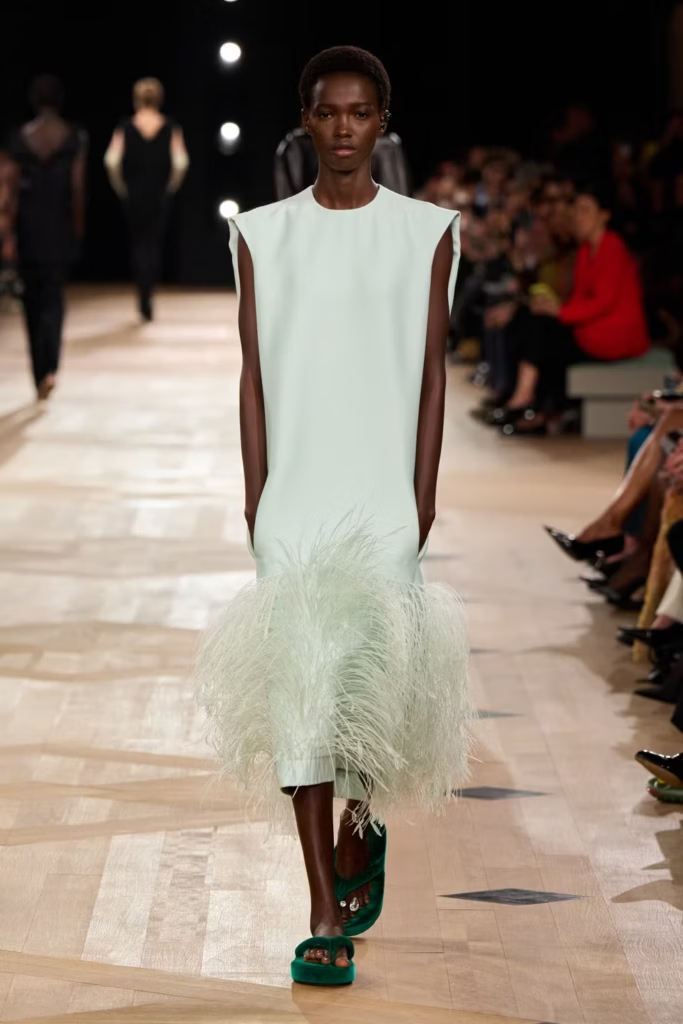
Perhaps the most striking change was Pierpaolo Piccioli, formerly of Valentino, stepping in at Balenciaga. His debut was read as a pivot back toward elegance, away from the more radical deconstructions of the house under Demna.
Piccioli reimagined the house’s heritage — introducing cocoon shapes, tunics, ball skirts, and a “neo gazar” fabric that nodded to Cristóbal Balenciaga’s architectural lineage.
His approach was more lyrical than confrontational. He retained occasional nods to recent Balenciaga edge (e.g., black-on-black, sculptural accessories) but recentered craftsmanship, form, and emotional weight.
Balenciaga’s reinvention under Piccioli suggests a new phase where structural innovation coexists with poetic restraint. The challenge will be: can this renewed classicism retain forward momentum without slipping into repetition?

Dior — Jonathan Anderson
Jonathan Anderson’s appointment at Dior was widely regarded as one of the season’s most ambitious bets.
His womenswear debut opened with a short film tracing Dior’s lineage and played out as a duet between archival memory and contemporary emotion.
Rather than overhaul, Anderson practiced a kind of “received reinterpretation”, leaning into tenderness, narrative, and a willingness to soften Dior’s sometimes austere rigor.
Dior is a house where legacy is both power and burden. Anderson’s first steps suggest a mode of direction that privileges empathy as much as authority. If successful, this approach could influence how designers enter legacy houses at large.

Bottega Veneta — Louise Trotter
In Milan, Bottega Veneta’s most notable change came via Louise Trotter, who became the house’s first female creative director.
She leaned into Bottega’s signature intrecciato — not as technique alone, but as a design philosophy. Her debut mixed fringe, tailored utility pieces, and thoughtful material contrasts (PVC, leather, shearling, taffeta).
Trotter’s first show struck a tone of quiet strength — less spectacle, more confidence in the product.
: Trotter’s appointment and debut mark an interesting convergence: gender progress, craft-forward detailing, and a hint that even “quiet luxury” needs a narrative glow.

Jean Paul Gaultier — Duran Lantink
After a hiatus from ready-to-wear, Jean Paul Gaultier’s comeback landed under the direction of Duran Lantink.
Lantink revived the house’s characteristic daring: sculptural forms, provocative cuts, theatrical flourishes. But he also seemed aware of the tension between art and wearability.
His debut was less about restraint and more about reminding us of Gaultier’s spirit of provocation, albeit with a new interpretive lens.
Gaultier’s relaunch is a litmus test: can a house infamous for excess re-enter the modern fashion dialogue without feeling anachronistic? Lantink’s boldness suggests yes — if done with enough intelligence.

Versace — Dario Vitale
Milan’s spotlight fell on Dario Vitale, making his debut after Donatella Versace stepped down following nearly 30 years of reign. As the first non-family designer to lead the house, Vitale balanced reverence with rebellion.
His SS26 collection unfolded in an intimate palazzo setting — a sensual mix of draped silks, undone belts, metallic accents, and raw edges that felt deliberately unrefined. The Medusa resurfaced in aged finishes, symbolizing continuity amid change.
Vitale’s debut captured a new kind of Versace confidence — less polished, more instinctive — signaling a generational shift where allure meets vulnerability.
Spring/Summer 2026 wasn’t about spectacle — it was about structure, restraint, and renewal. Each new creative director honored the DNA of their house while daring to whisper something new.
By The Fashion Consult